 Download the App
Crochet Hook Size Chart: Complete Guide to US, UK & Metric Sizes
8 Jul, 2026
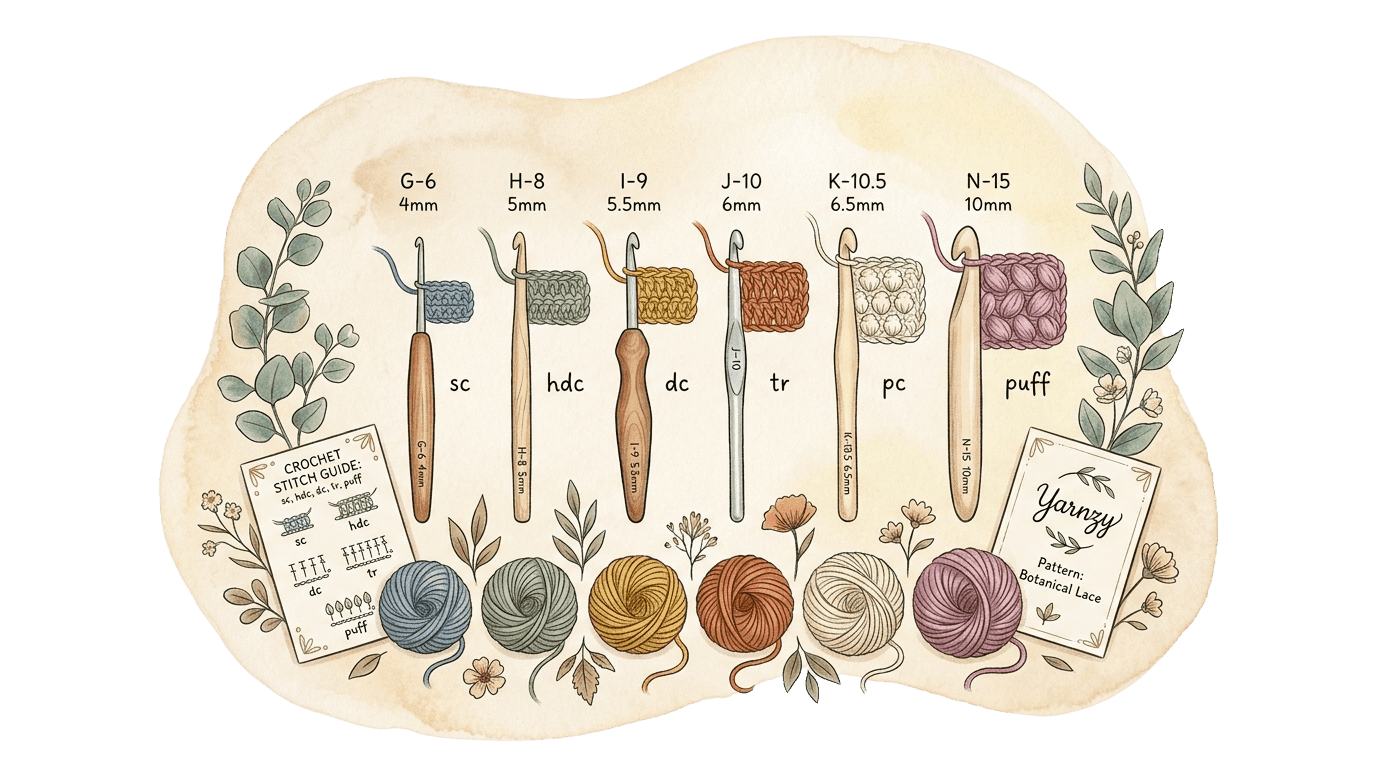
A crochet hook size chart shows conversions between three different sizing systems: metric (millimeters, universal standard), US letters (B through S, larger letters = larger hooks), and UK numbers (opposite logic, smaller numbers = larger hooks). A US H/8 hook equals UK 6 equals 5.0mm, all the same hook. Modern hooks are standardized with metric measurements on the handle. Charts convert between all three systems and recommend yarn weights for each hook size. Metric is most reliable.
Download Crochet Tools & Start Your Project Today
 Download Yarnzy free
Standard Crochet Hook Size Conversion Table
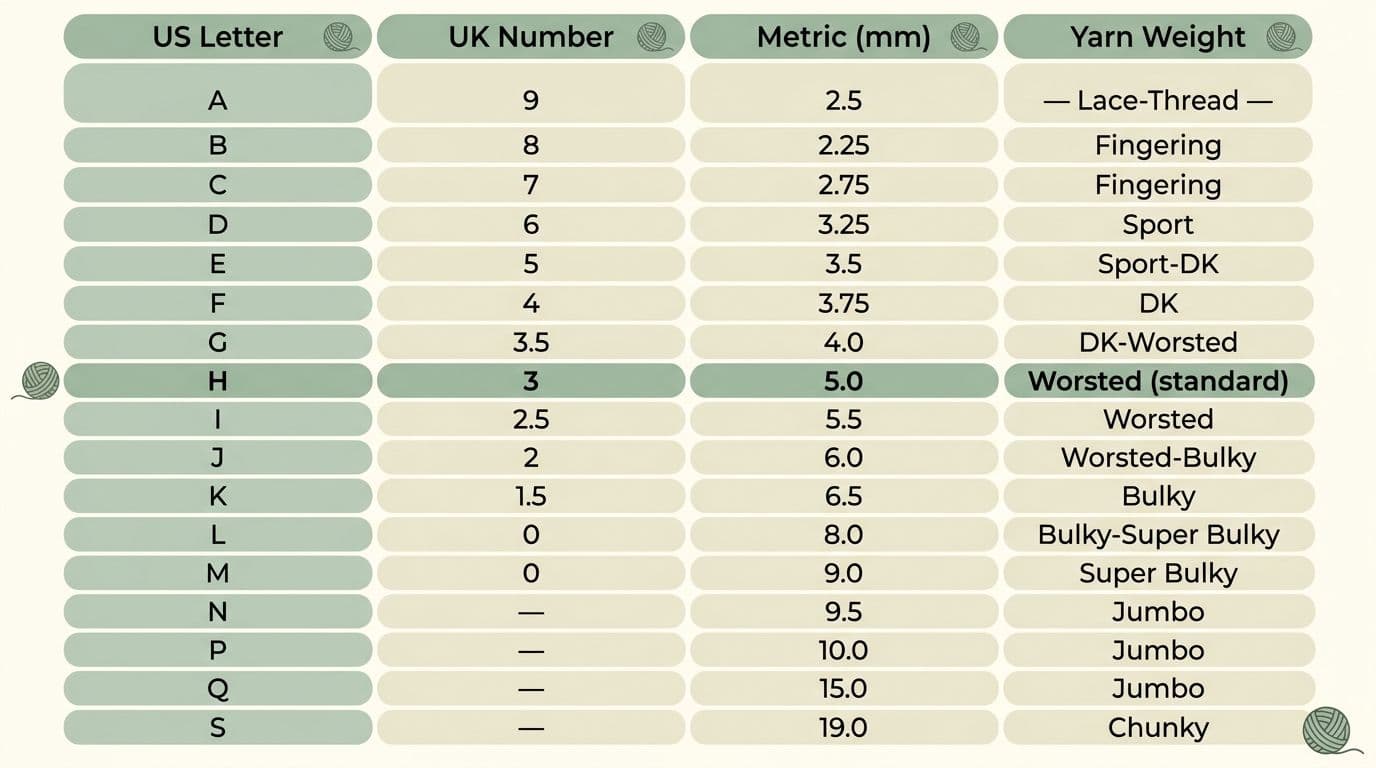
Here's the complete official conversion table. Bookmark this. Screenshot it. Print it.
| US Letter | UK Number | Metric (mm) | Yarn Weight |
|---|---|---|---|
| A | 9 | 2.5 | Lace/Thread |
| B | 8 | 2.25 | Fingering |
| C | 7 | 2.75 | Fingering |
| D | 6 | 3.25 | Sport |
| E | 5 | 3.5 | Sport/DK |
| F | 4 | 3.75 | DK |
| G | 3.5 | 4.0 | DK/Worsted |
| H | 3 | 5.0 | Worsted (STANDARD) |
| I | 2.5 | 5.5 | Worsted |
| J | 2 | 6.0 | Worsted/Bulky |
| K | 1.5 | 6.5 | Bulky |
| L | 0 | 8.0 | Bulky/Super Bulky |
| M | 0 | 9.0 | Super Bulky |
| N | — | 9.5 | Jumbo |
| P | — | 10.0 | Jumbo |
| Q | — | 15.0 | Jumbo |
| S | — | 19.0 | Chunky |
Key insight: Size H (5.0mm) is the golden ratio. Most beginner-friendly yarn is worsted weight, using H, I, or J hooks.
What Is the Standard Crochet Hook Size Chart Used by Popular Brands?
The major crochet hook manufacturers—Boye, Clover, Knitter's Pride, Susan Bates, Caron, Red Heart, and Lily—all follow the same baseline sizing standard based on metric millimeters.
Boye (founded 1867) created the original US letter system. They established the standard, and other manufacturers adopted it to stay compatible. So theoretically, a size H hook from Boye should equal 5.0mm, same as Clover or Knitter's Pride.
Here's the reality: They're "approximately" the same. In practice:
• Boye H = 4.95mm
• Clover H = 5.05mm
• Knitter's Pride H = 5.0mm exactly
These tiny differences (0.1mm) don't matter for most projects. But if you're working with delicate yarn, need exact gauge for amigurumi, or have tight hand tension, you'll notice.
Answer: Different manufacturing processes, different quality control standards, and legacy systems that nobody wants to change. It's not malicious, it's just history.
The official standards come from Craft Yarn Council (US), UK Crafts Council (UK), and ISO (metric). All major brands follow them, but slight variances persist.
Where Can I Find a Crochet Hook Size Chart for Different Materials?
Different materials (aluminum, bamboo, ergonomic) don't change sizing—size is based on shaft diameter. But finding charts matters.
Free Official Sources:
• Craft Yarn Council (craftyarncouncil.com), Official standards, free PDF
• Boye (boye.com), Official sizing chart
• Clover (cloverusa.com), Sizing guide for all hooks
• Knitter's Pride (knittersopride.com), Complete chart
• Red Heart Yarn (redheartyarn.com), Free downloadable
Free Online:
• Ravelry.com, Community charts
• Pinterest, Free infographics
Paid/Printable:
• Etsy, Professional PDFs ($3-8)
• Amazon, Laminated cards ($5-10)
• Crochet books, Comprehensive charts
US Crochet Hook Letter Sizes to Metric in Millimeters
Complete US-to-metric conversion, organized by yarn weight:
Lace/Fingering: A (2.5mm) | B (2.25mm) | C (2.75mm)
Sport/DK: D (3.25mm) | E (3.5mm) | F (3.75mm)
Worsted: G (4.0mm) | H (5.0mm) | I (5.5mm) | J (6.0mm)
Bulky: K (6.5mm) | L (8.0mm) | M (9.0mm)
Jumbo: N (9.5mm) | P (10.0mm) | Q (15.0mm) | S (19.0mm)
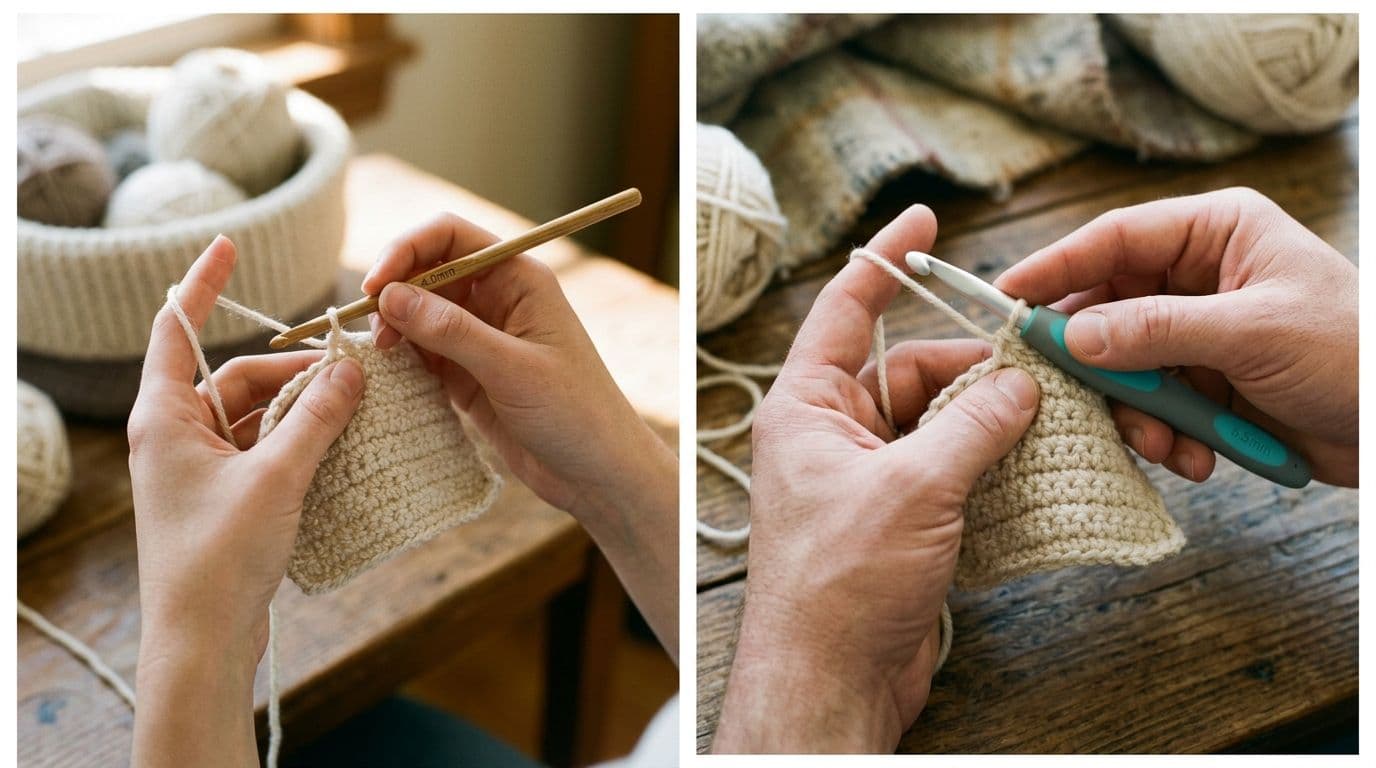
Hand Size Considerations: Choosing Hooks for Small vs Large Hands
This is something most guides skip: your actual hand size matters.
Small Hands
If you have small hands, large hooks (K, L, M+) will feel awkward. Your hand can't wrap around them comfortably.
Best sizes for small hands: F, G, H, I, J (3.75-6.0mm) Avoid: Q, S (too thick to grip comfortably) Material: Bamboo or slim ergonomic (thinner than standard cushioned)
Small-handed crocheters often find they naturally make tighter tension because they can't control larger hooks as easily. This is normal. Embrace it.
Large Hands
If you have larger hands, tiny hooks (A, B, C) feel fussy and tire your hands quickly.
Best sizes for large hands: H, I, J, K, L (5.0-8.0mm) Work better: Anything medium or larger Material: Thicker handles feel more comfortable in larger hands
Large-handed crocheters often make looser tension naturally. Compensate by going down one size if needed.
Solution
Start with size H (5.0mm). Work a small swatch. If it feels too thick or too thin for your hand specifically, adjust. Your comfort matters more than the pattern's recommendation.
Handle Width & Grip Specifications: The Comfort Factor
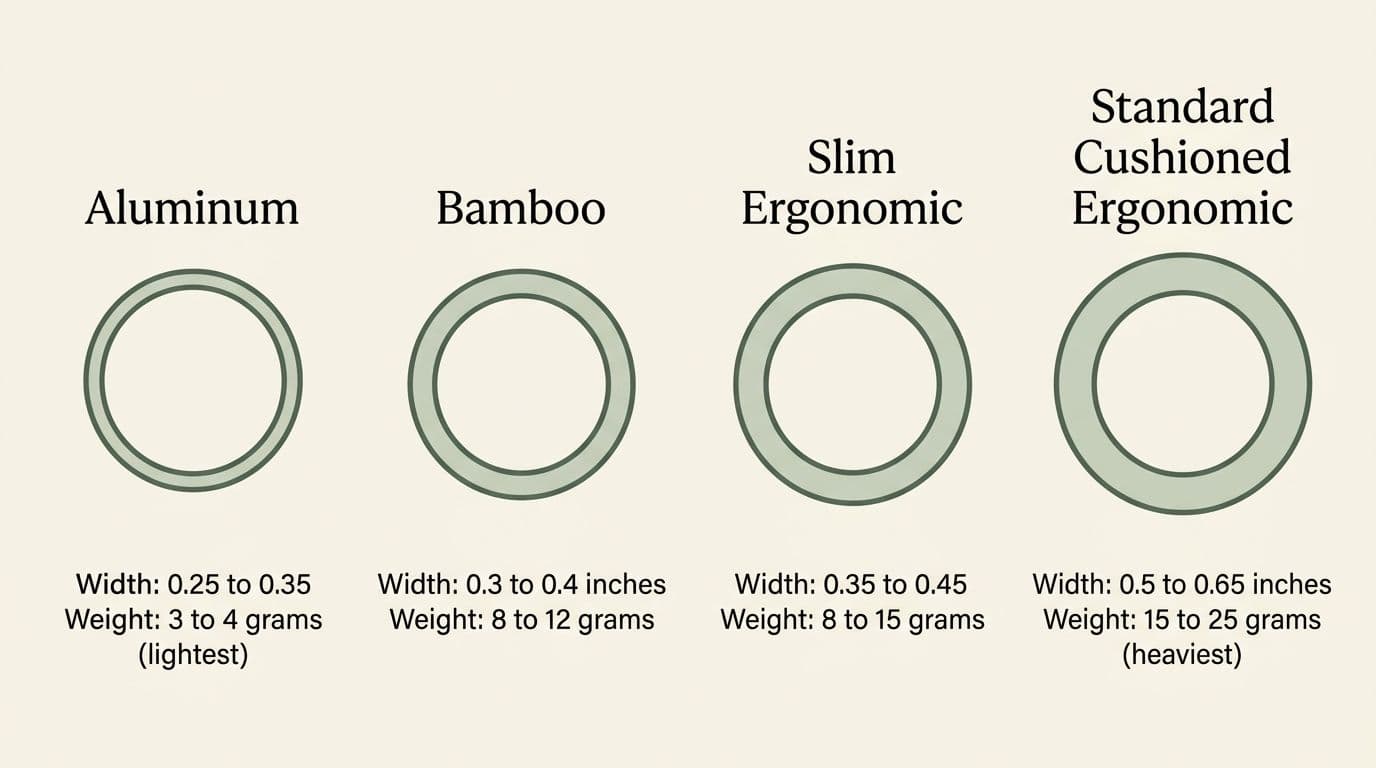
Nobody talks about this, but handle width dramatically affects comfort.
Standard aluminum hooks: 0.25-0.35 inches wide (thin, can feel harsh)
Bamboo hooks: 0.3-0.4 inches (slightly wider, warmer)
Standard cushioned ergonomic: 0.5-0.65 inches (thick, very comfortable)
Slim ergonomic: 0.35-0.45 inches (middle ground)
Weight by material (typical size H hook):
• Aluminum: 3-4 grams (lightest)
• Bamboo: 8-12 grams (medium)
• Standard cushioned ergonomic: 15-25 grams (heaviest, but most comfortable)
• Slim ergonomic: 8-15 grams (balanced)
If you have arthritis or hand pain, thicker handle + lighter weight = comfort. If you don't have pain, thinner handles work fine.
Material Deep-Dive: Aluminum, Bamboo, Ergonomic, Wood, Steel
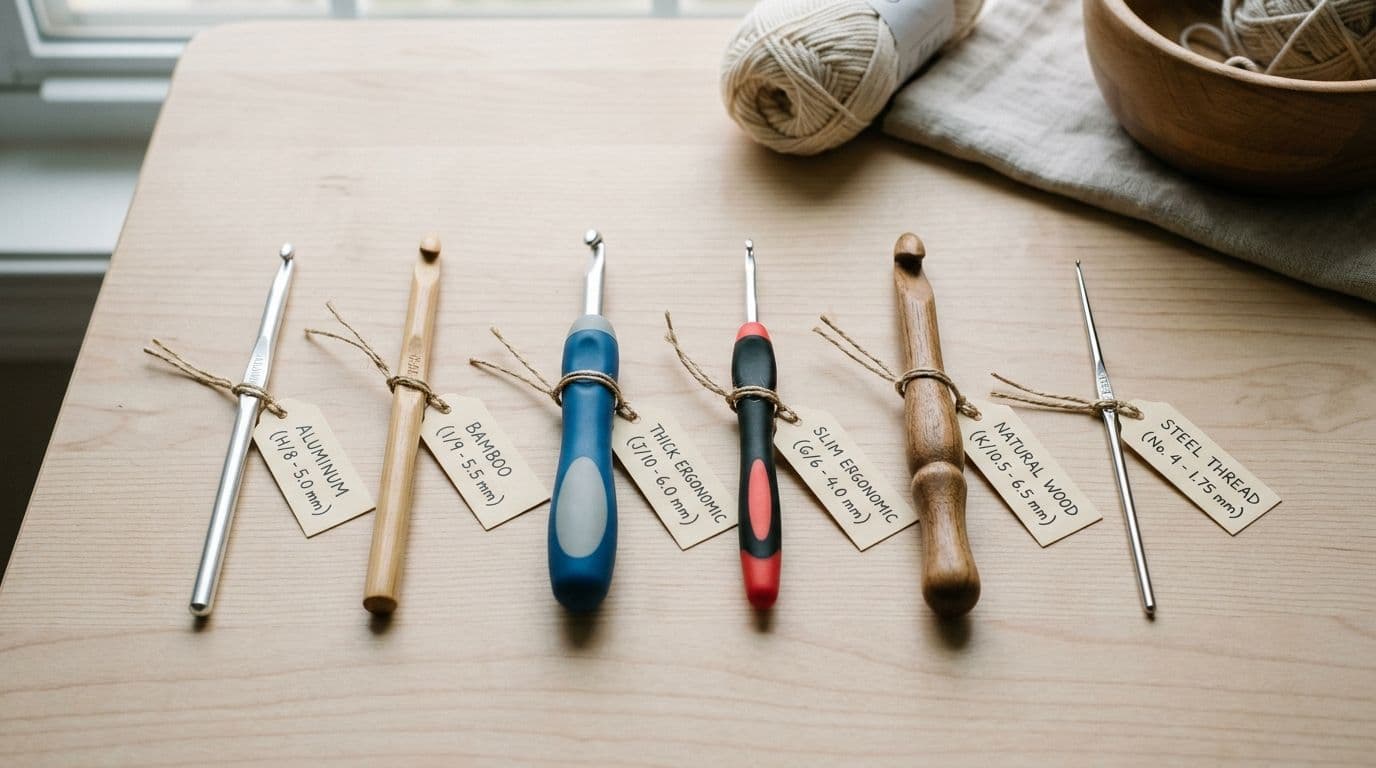
Aluminum (Most Popular)
Feel: Cool, smooth, fast-gliding Weight: Lightest (3-4g for size H) Handle width: 0.25-0.35 inches (thin) Speed: Yarn slides fast Cost: $1-5 per hook Best for: Speed crocheters, warm-handed people, budget buyers Drawbacks: Makes hands cold, can feel harsh in long sessions
Bamboo (Eco-Conscious)
Feel: Warm, slightly grippy, meditative Weight: Medium (8-12g for size H) Handle width: 0.3-0.4 inches Speed: Yarn grips more (slower, easier control) Cost: $3-8 per hook Best for: Cold hands, eco-conscious, beginners who want control Drawbacks: Slower crochet speed, can splinter if dropped
Ergonomic - Standard Cushioned (Most Comfortable)
Feel: Padded, warm, supportive Weight: Heavy (15-25g for size H) Handle width: 0.5-0.65 inches (thick) Speed: Normal speed Cost: $10-20 per hook Best for: Arthritis, hand/wrist pain, long sessions Brands: Knitter's Pride, Clover Soft Touch, Susan Bates Soft Touch Drawbacks: Most expensive, takes up bag space
Ergonomic - Slim (Balanced Comfort)
Feel: Slightly padded, warm, lighter Weight: Medium (8-15g) Handle width: 0.35-0.45 inches Speed: Normal Cost: $8-12 per hook Best for: Mild hand discomfort, want some padding without bulk Brands: Some Knitter's Pride, specialized brands
Wood (Artisan/Specialty)
Feel: Warm, beautiful, crafted Weight: Medium-heavy Handle width: Variable (0.35-0.5 inches) Speed: Slow (like bamboo) Cost: $10-30+ (handmade) Best for: Collectors, aesthetics, artisan lovers Drawbacks: Fragile, slow, expensive
Steel (Thread Crochet Only)
Feel: Cold, very durable Weight: Heavy Cost: $3-10 Best for: ONLY thread crochet (tiny doilies, fine work) Note: NOT for regular yarn projects. Different sizing system.
Tension Control: How Hook Size Affects Your Natural Tension
This is crucial and rarely explained: your natural tension affects which size you should use.
Tight Tension
If you naturally crochet tight, your stitches are dense.
Problem: Using the pattern's recommended size often makes fabric too tight Solution: Go UP one size (from H to I, for example) Why: Larger hook compensates for tight tension
Signs of tight tension:
• Finished fabric feels stiff
• Stitches look small/dense
• You struggle with bigger hooks
Best materials: Aluminum or bamboo (easier to feel the stitches when tense)
Loose Tension
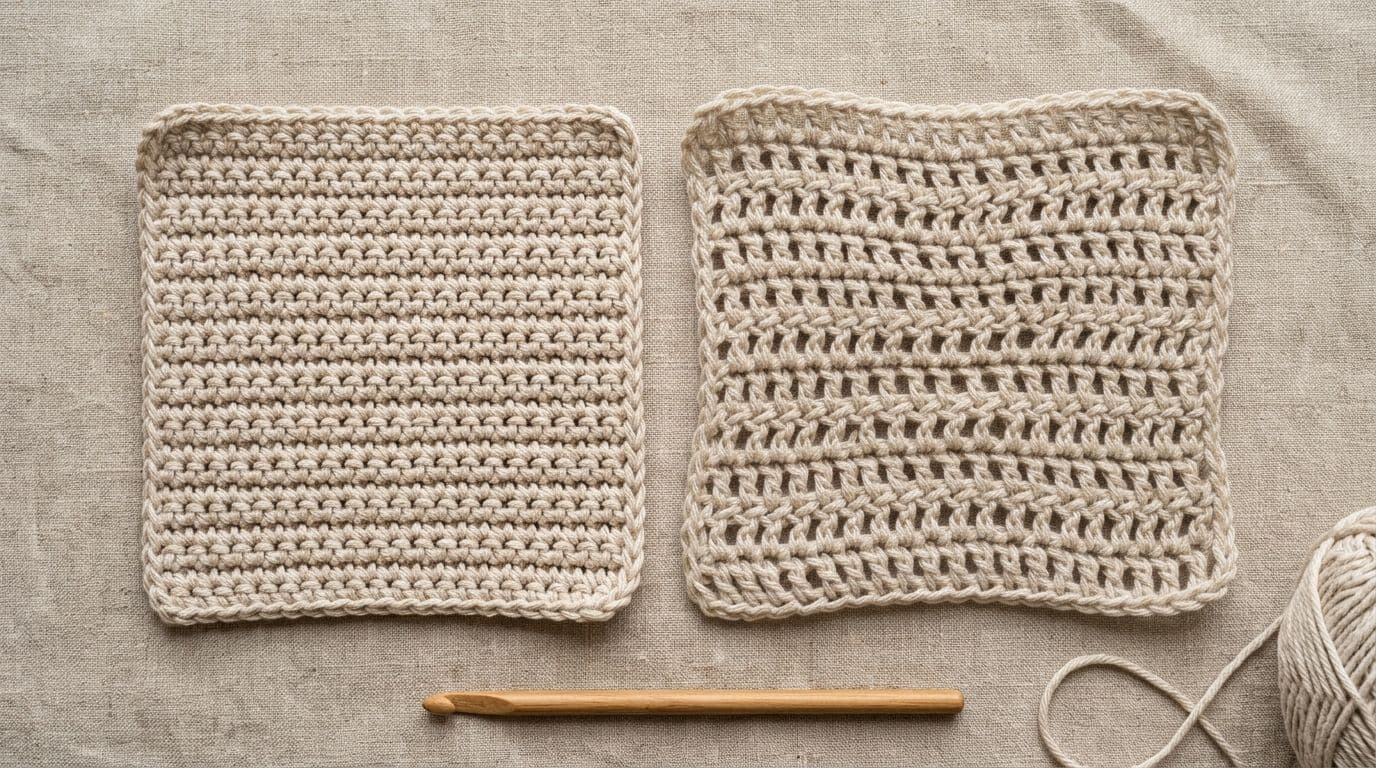
If you naturally crochet loose, your stitches are open.
Problem: Using the pattern's recommended size often makes fabric too loose Solution: Go DOWN one size (from H to G, for example) Why: Smaller hook compensates for loose tension
Signs of loose tension:
• Finished fabric feels floppy
• Stitches look big/open
• Finished items sag or stretch easily
Best materials: Bamboo (grips more, helps you control loose tension)
Solution
Test on a swatch using the pattern's recommended size. If fabric doesn't match the pattern photo, adjust hook size, not tension. You can't change natural tension, work with it.
Beginner Hook Recommendations: Specific Models & Where to Buy
Don't overthink this. Here are the exact hooks to recommend beginners:
Absolute Beginner (First Hook Ever)
Best choice: Clover Amour (aluminum) size H
• Cost: $3-5
• Smooth, fast, beginner-friendly
• Available everywhere (Walmart, craft stores, Amazon)
• Comfortable to hold
Why: Light, affordable, quality, easy to find
Beginner Starter Set (3 hooks)
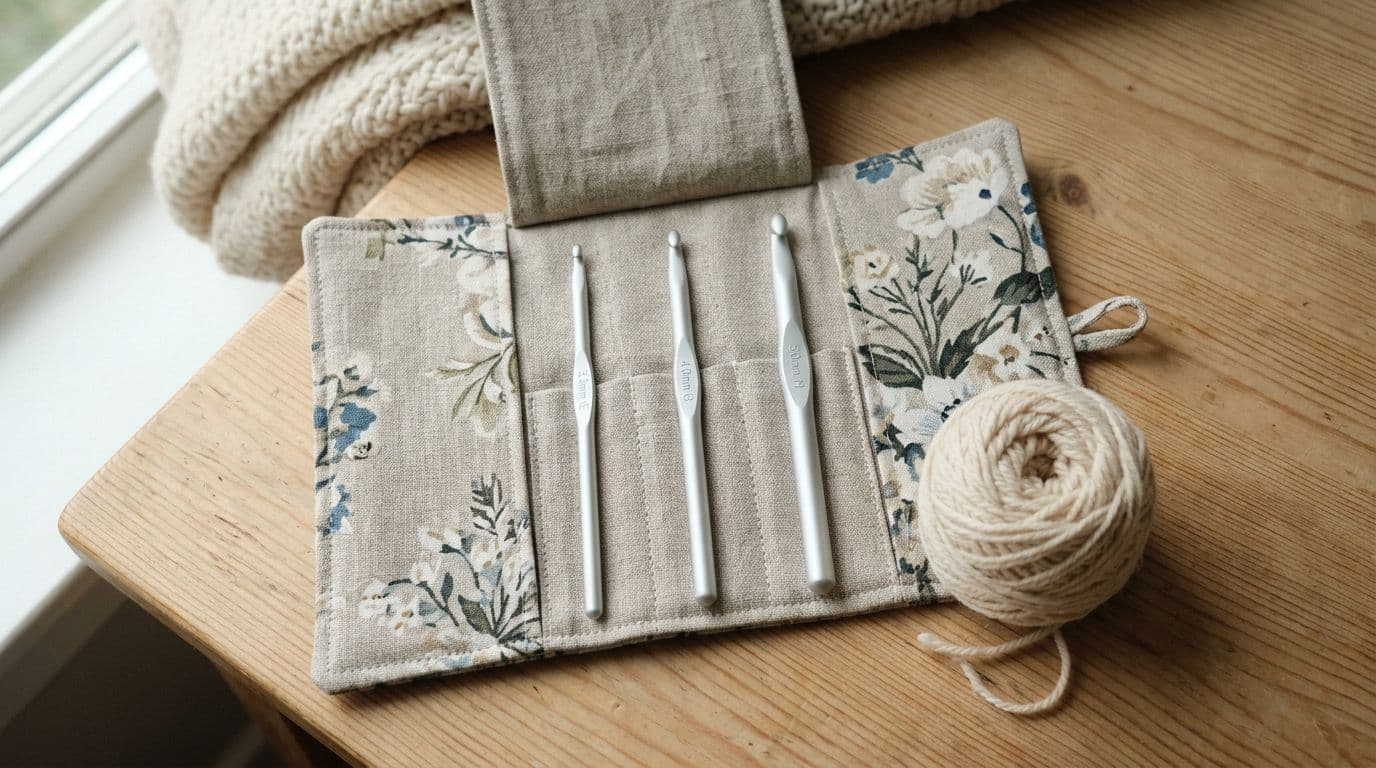
Best set: Clover Amour set (H, I, J)
• Cost: $12-15 total
• Three most common sizes
• All aluminum, smooth
• One box, easy to carry
Where to buy: Amazon, Joann, Michaels (often on sale)
Beginner with Hand Pain
Best choice: Clover Soft Touch size H
• Cost: $6-8
• Padded but affordable
• Good for testing if you need cushioning
• Covers hand pain without expensive investment
Why: Padding without breaking the budget. If you like it, upgrade to Knitter's Pride later.
Beginner Who Loves It (Committed)
Best upgrade: Knitter's Pride Smartstix size H
• Cost: $12-15
• Premium comfort, still not too expensive
• Beautiful design
• Will last years
Why: Good balance of quality and comfort for someone serious
Budget-Conscious Beginner
Best option: Lily aluminum set
• Cost: $5-8 for 3 hooks
• Simple, functional
• Available in Walmart
• Gets the job done
Why: Cheapest quality option. You can upgrade later if you want.
Hook Maintenance & Durability: When Hooks Need Replacement
Hooks wear out. You should know when.
Aluminum Hooks
Lifespan: 5-10 years Signs of wear: Rough spots, burrs, bent shaft How to maintain: Wipe clean, store dry When to replace: When surface becomes rough (snagging yarn)
Bamboo Hooks
Lifespan: 3-7 years Signs of wear: Splinters, cracks, rough surface How to maintain: Wipe clean, avoid excess water When to replace: When splinters appear (painful)
Ergonomic (Cushioned)
Lifespan: 5-10 years Signs of wear: Padding wears down, handle becomes less cushioned How to maintain: Wipe clean, avoid extreme heat When to replace: When padding deteriorates (defeats the purpose)
Steel Hooks (Thread)
Lifespan: 20+ years Signs of wear: Rust, corrosion How to maintain: Keep dry When to replace: Rarely needed (very durable)
Visual Size Progression: How to Judge Hook Size by Looking
You can't accurately judge hook size by looking. This is a myth. But here's how to compare:
• Tiny (A, B, C): Thinner than a pencil
• Small (D, E, F, G): About pencil thickness
• Standard (H, I, J): Thicker than a pencil, comfortable grip width
• Large (K, L, M): Much thicker, feels substantial
• Jumbo (N+): Very thick, obvious bulk
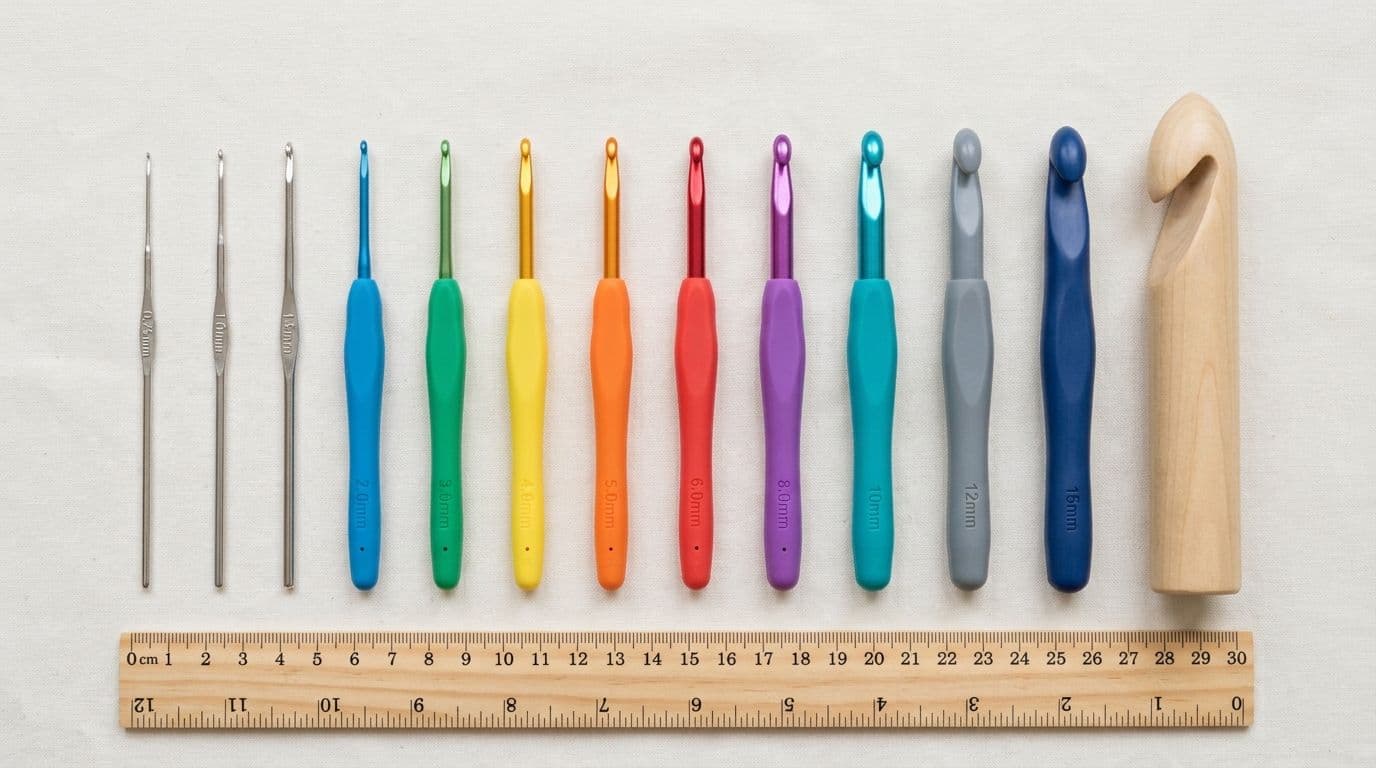
Real test: Hold three sizes together (say F, H, J). You'll immediately see the progression. That's how you recognize size differences.

Find Your Perfect Hook Size Instantly Already know your yarn weight? The Hook & Needle Chart shows you the exact size in all three systems—US, UK, and metric..
Pain Reduction for Crochet: Solutions for Hand, Wrist & Shoulder Pain
Crochet shouldn't hurt. If it does, there are solutions.
Hand Pain Causes & Solutions
Cause: Small hooks + tight tension
Solution: Go up 1-2 sizes, use ergonomic hook, bamboo material
Cause: Thin handle grip (aluminum)
Solution: Wrap handle with athletic tape (DIY cushioning), or switch to ergonomic
Cause: Arthritis or weak hands
Solution: Knitter's Pride ergonomic hooks (most padding), or Furls artisan (expensive but worth it)
Cause: Cold hands
Solution: Bamboo or ergonomic (both warm). Aluminum makes it worse.
Wrist Pain Causes & Solutions
Cause: Repetitive motion strain
Solution: Take breaks every 30 minutes, stretch wrists, use proper posture
Cause: Wrong hook size
Solution: Try different sizes. Sometimes larger hooks put less strain than smaller.
Cause: Poor hand position
Solution: Hold hook loosely, don't grip tight, let yarn do the work
Shoulder Pain Causes & Solutions
Cause: Poor posture while crocheting
Solution: Sit upright, bring yarn to you (not you to yarn), take breaks
Cause: Tension in neck
Solution: Relax shoulders, don't hunch, position work at eye level
International Hook Sizing: European, Japanese & Other Standards
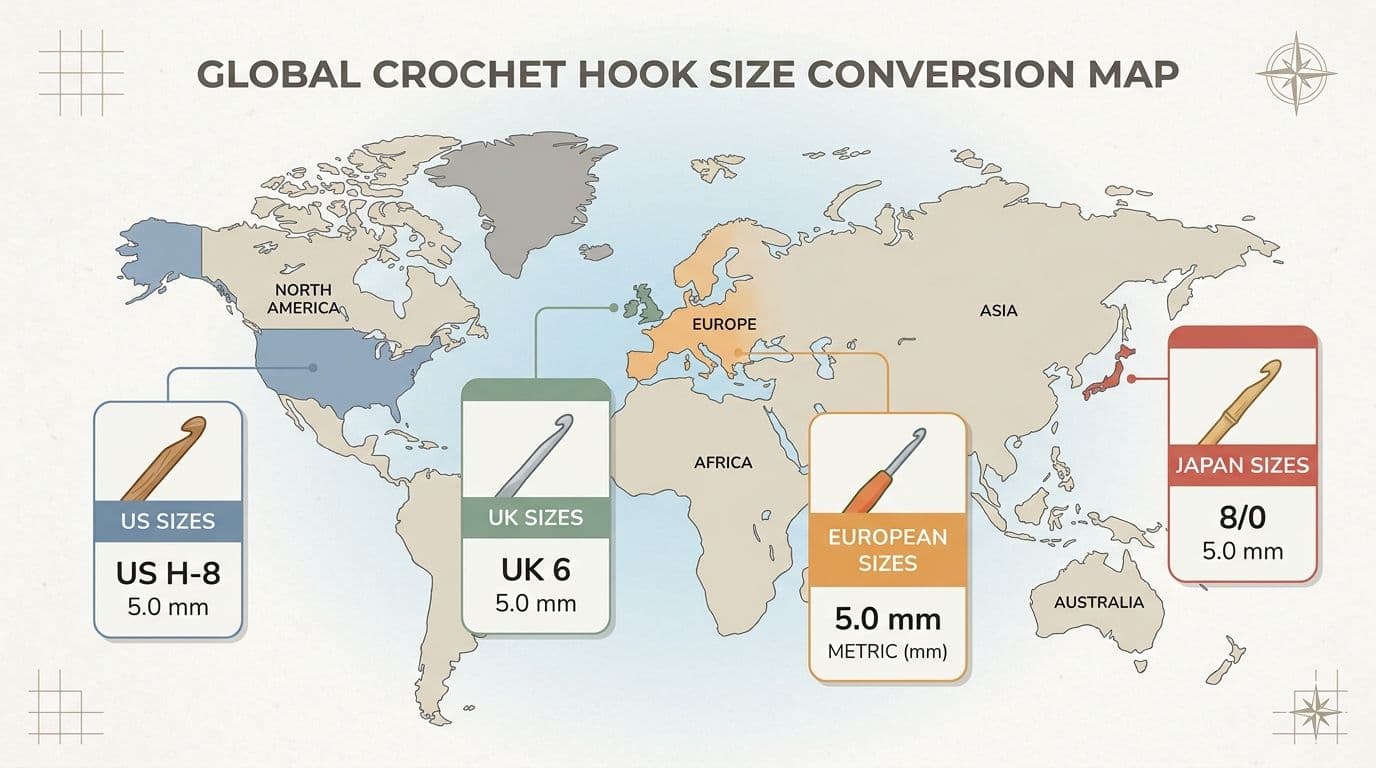
European Sizing
Europe uses metric (mm) exclusively. No US letters, no UK numbers. 3.0mm, 4.0mm, 5.0mm, etc.
Conversion: Same as metric column in our conversion table How to use: Find metric size in table, convert to US letter
Japanese Hook Sizing
Japan has its own system. Numbers don't match any other system.
Examples:
• Japanese 7/0 ≈ US E (3.5mm)
• Japanese 10/0 ≈ US D (3.25mm)
• Japanese 4/0 ≈ US I (5.5mm)
Real solution: If you find a vintage Japanese hook, measure it in millimeters and match to a metric column.
Australian Sizing
Australia follows UK sizing (not US). Same numbering as UK.
Conversion: Use UK column in conversion table
Amigurumi Hook Sizing: Why Smaller Hooks Work
Amigurumi (stuffed toys) breaks the standard yarn-weight-to-hook-size rule.
Pattern says "use worsted weight yarn" but calls for a hook TWO sizes smaller than yarn recommends.
Why: Stuffing pokes through gaps. A smaller hook tightens fabric without making it stiff.
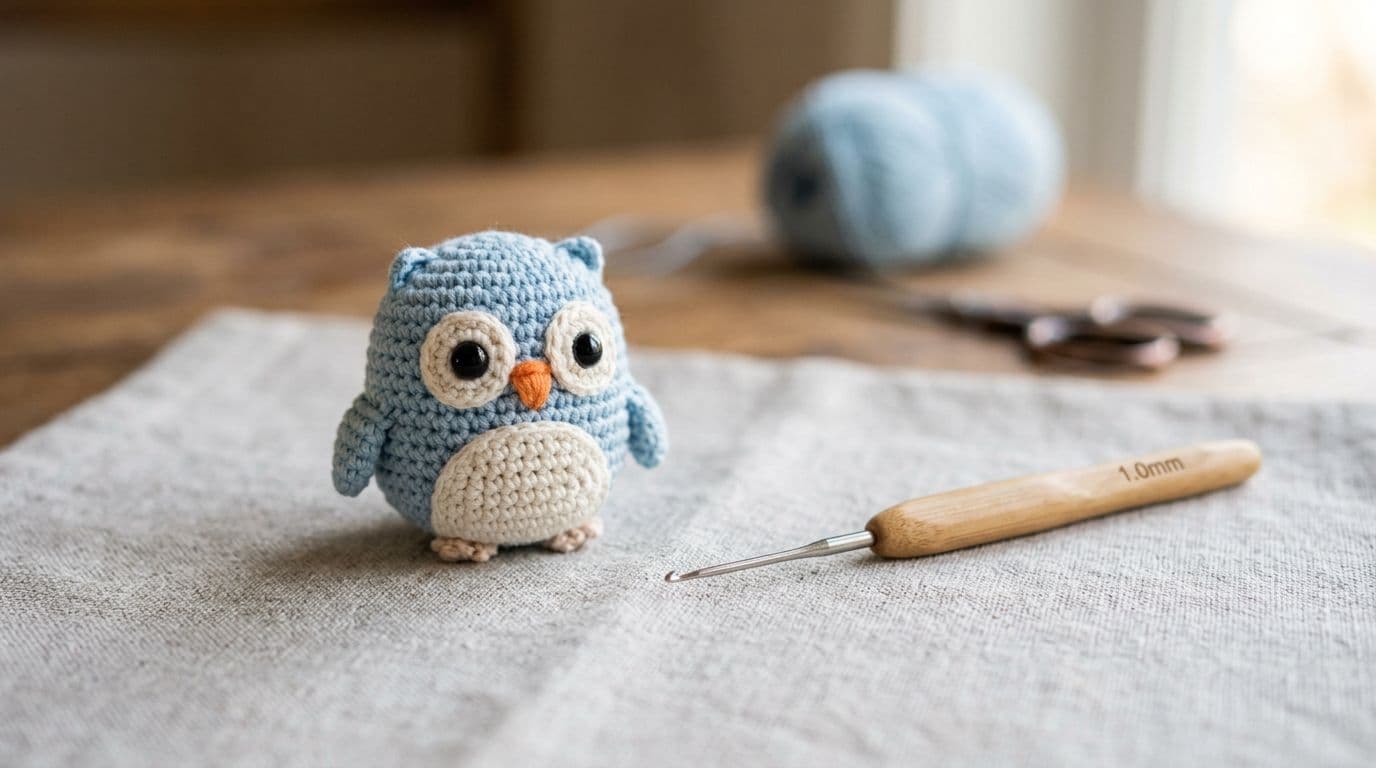
Example:
• Yarn recommends: US H (5.0mm)
• Amigurumi pattern says: US F (3.75mm)
You're crocheting worse weight with a small hook. That's intentional. Tighter fabric holds stuffing in.
Project-Type Specific Recommendations
Different projects need different hook sizes for best results:
Blankets & Afghans: H, I, J (5.0-6.0mm), Standard worsted
Amigurumi: 2-3 sizes smaller than yarn recommends, Tight fabric
Lace Shawls: C, D, E, F (2.75-3.75mm), Delicate work
Tunisian Crochet: Same as yarn recommends, Different stitch, same tension
Baby Items: F, G, H (3.75-5.0mm), Softer, denser fabric
Summer Garments: I, J, K (5.5-6.5mm), Open, breathable fabric
Winter Garments: G, H, I (4.0-5.5mm), Dense, warm fabric
Doilies (Thread): Steel hooks (special sizing), Very small
Quick Projects (Chunky): Q, S (15-19mm), Fast work
How to Read a Crochet Hook Size Chart for Beginners
Step 1: Find Your Yarn's Recommended Size
Look at the yarn label. There's a hook icon with a number/letter. That's your starting point.
Step 2: Look Up on Chart
Find that size on the chart. Trace across.
Example: Yarn says "US H" Chart shows: H = 5.0mm = UK 3
Step 3: Grab That Hook
Find a hook labeled with any of those three names.
Step 4: Swatch (Recommended)
Crochet 4×4 inches. If fabric matches the pattern photo, correct size. If too tight/loose, adjust.
Common Confusions Solved
"Why three numbers?" — Three different naming systems. All measure the same thing.
"Which should I use?" — Use whichever your hook is labeled.
"My yarn says 'worsted' but no size?" — Worsted = H, I, or J. Pick middle one (I).
"My hook label is gone?" — Measure shaft in mm. Match to metric column.

Calculate Your Exact Stitch Count Once you know your hook size, use the Stitch Calculator to convert your gauge into exact cast-on counts. No more math on envelopes.
Final Thoughts
A crochet hook size chart is a translation tool. The three systems measure the same thing. The chart helps you convert.
What separates beginners from experienced crocheters: understanding why systems exist, troubleshooting when things don't work, and knowing that your hands are the real teachers.
Your swatch measurement and your hands matter more than any chart.
Explore More Crochet Tools on Yarnzy
Need help matching yarn, calculating stitches, or finding substitutions? Explore all our crochet tools and guides to find everything you need for your next project.
Visit Yarnzy Crochet Resources
Frequently Asked Questions
They're three different naming systems that all measure the same thing (hook shaft diameter). The US uses letters (A-S), the UK uses numbers (0-10+), and metric uses millimeters (2.5mm-19mm). They exist because different regions developed their own systems historically. Use whichever your hook or pattern specifies, they're all identical sizes, just different names.
Share this page
 X / Twitter
 Facebook
 Reddit
Related articles
Crochet Abbreviations: The Complete Guide to Stitches, Terms & Symbols (US & UK)

Types of Crochet Stitches: Guide to Chain, Single, Double, Half Double, Triple & Slip Stitch
How to Read a Knitting Pattern - Yarnzy Beginner Cheat Sheet

Yarnzy: #1 Crochet & Knitting App
Track knitting and crochet projects with a timer & row counter, Import Patterns from Anywhere, Manage Stash & more all in one place.


Free to start · iOS, Android & Web
Scan to Download the App
Start your next project with confidence