
 Download the App
Yarn Substitution Guide: How to Replace Any Yarn Without Ruining Your Project
25 Jun, 2026
Yarn substitution means replacing the pattern-recommended yarn with a different yarn while maintaining similar results. To substitute safely, match three factors: yarn weight (same thickness category to maintain stitch size), yardage (total meters/yards needed), and fiber content (fiber affects drape, stretch, and care). Always make a gauge swatch with your substitute yarn to verify it behaves similarly. If the substitute yarn is thinner, you need more yardage; if thicker, you need less. Yarnzy Yarn Substitution Calculator simplifies the math automatically.
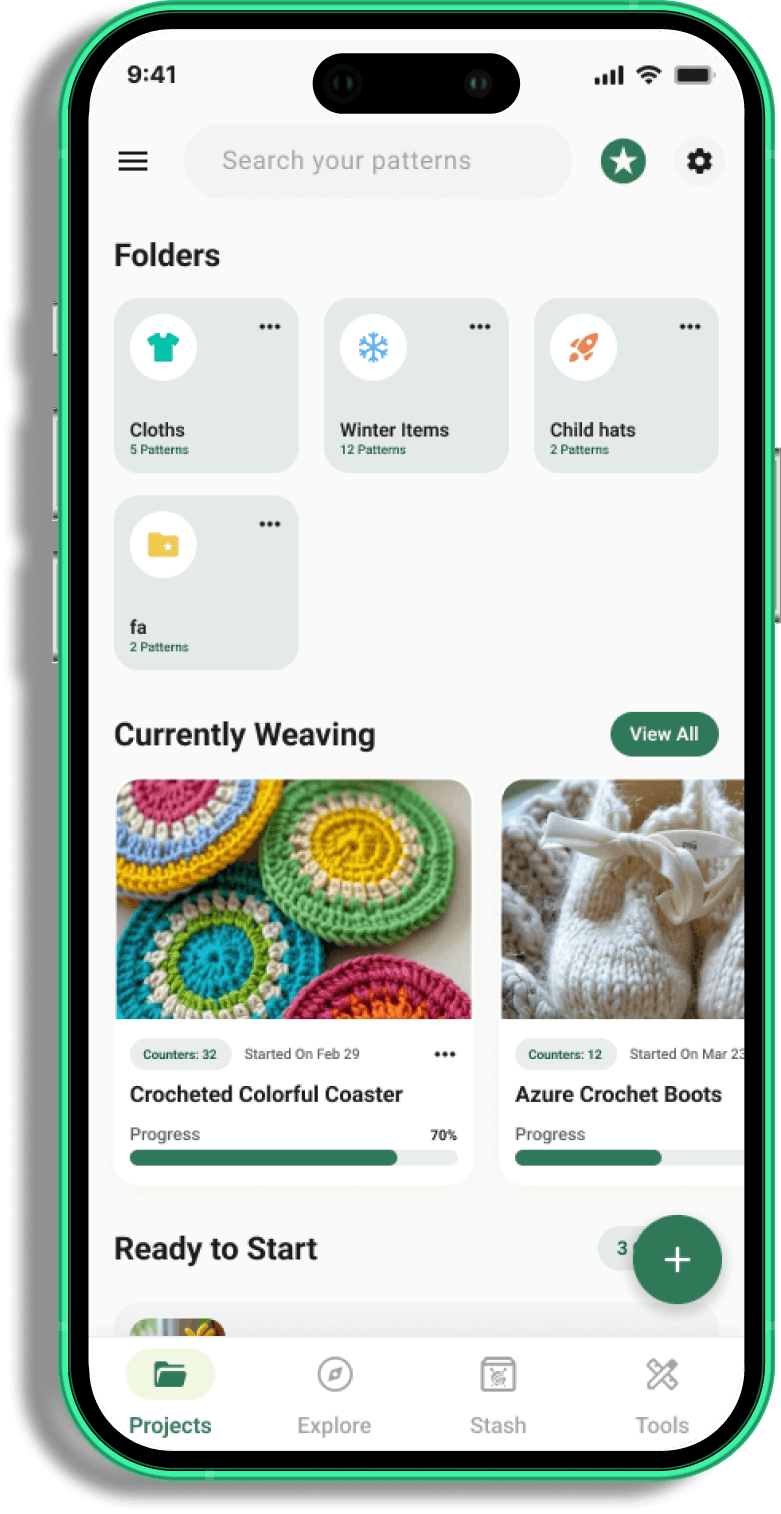
Stop Guessing. Let YarnZy Do the Heavy Lifting.
 Download YarnZy Free
The 6 Factors That Actually Determine a Good Yarn Substitute
1. Yarn Weight
Match the yarn weight first but understand what "matching" actually means. The weight label (worsted, DK, bulky) is a range, not a fixed specification. A light worsted and a heavy worsted are both labeled "worsted," but they can knit to completely different gauges.
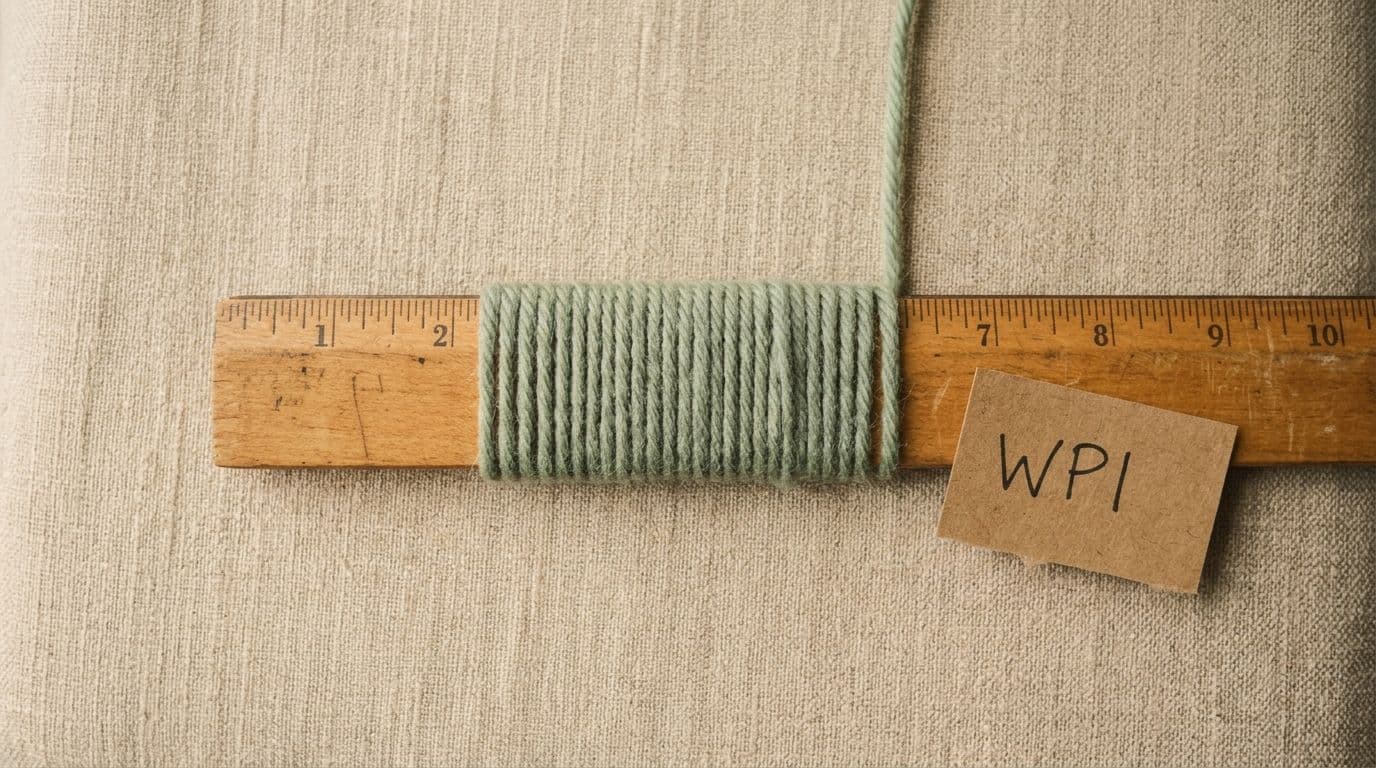
The most reliable confirmation is wraps per inch (WPI): wrap your yarn around a ruler for one inch and count. This gives you the true weight, regardless of what the label says.
Yarn Weight Equivalents Chart:
| CYC # & Category | WPI | Knit Gauge (4") | US Needle | UK Needle (Old) | Metric Needle / Hook | US Crochet Hook |
|---|---|---|---|---|---|---|
| 0 - Lace | 30–40+ | 32–40 sts | 000–1 | 14–17 | 1.5–2.25 mm | Regular steel hook / B-1 |
| 1 - Super Fine / Fingering | 19–22 | 27–32 sts | 1–3 | 11–13 | 2.25–3.25 mm | B-1 to E-4 |
| 2 - Fine / Sport | 15–18 | 23–26 sts | 3–5 | 9–11 | 3.25–3.75 mm | E-4 to 7 |
| 3 - Light / DK | 12–15 | 21–24 sts | 5–7 | 7–9 | 3.75–4.5 mm | 7 to I-9 |
| 4 - Medium / Worsted (Aran) | 9–11 | 16–20 sts | 7–9 | 5–7 | 4.5–5.5 mm | I-9 to K-10.5 |
| 5 - Bulky | 7–8 | 12–15 sts | 9–11 | 0–5 | 5.5–8.0 mm | K-10.5 to M-13 |
| 6 - Super Bulky | 5–6 | 7–11 sts | 11–17 | 000–0 | 8.0–12.75 mm | M-13 to Q |
| 7 - Jumbo | <4 | 6 sts & under | 17+ | — | 15.0 mm+ | Q, S, & larger |
2. Yardage Per Gram
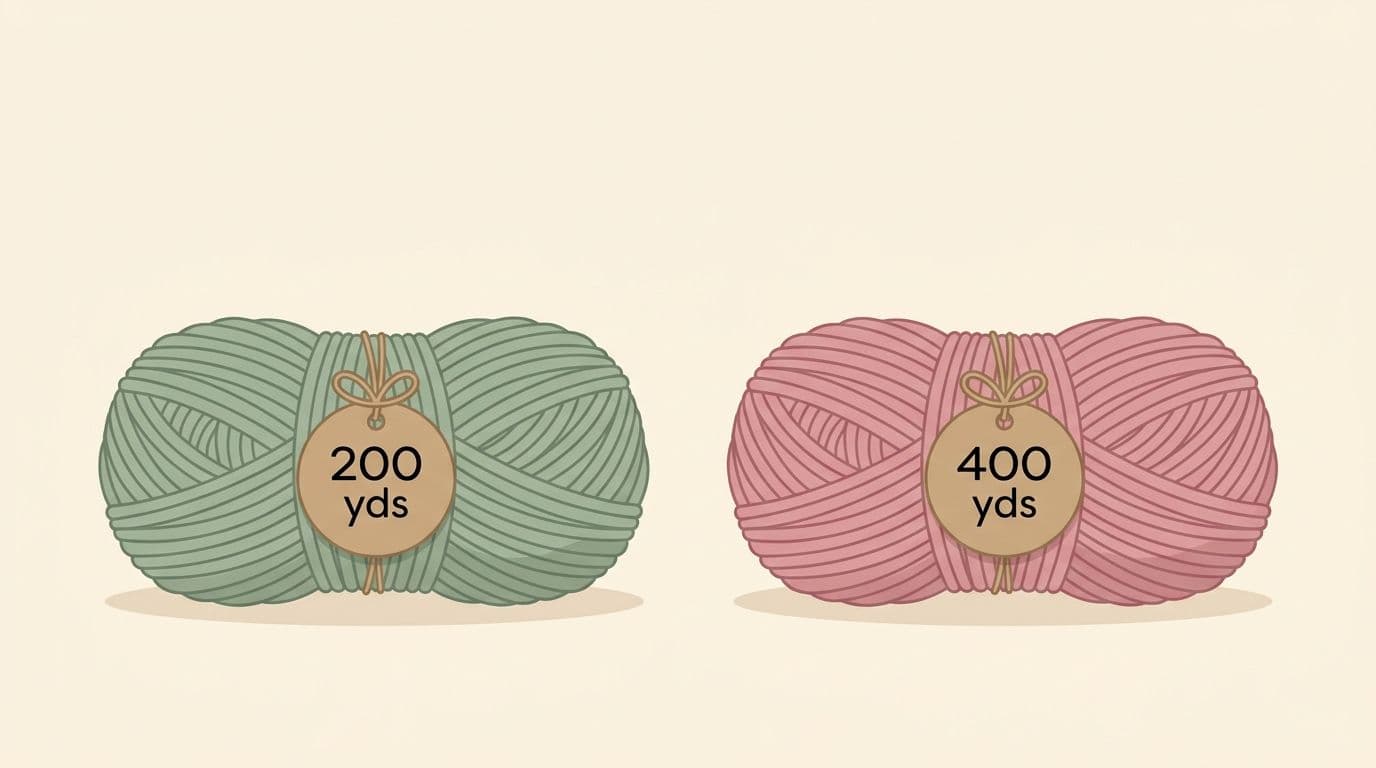
This is where most substitutions go wrong. Two skeins can both weigh 100g but contain wildly different yardage one might have 200 yards, another 400. If you swap them skein-for-skein, you could run out halfway through your project.
Always compare yards per gram (or meters per gram), not just total yardage per skein. Divide the total yardage by the skein weight to find it. A difference of more than 10–15% means you need to recalculate how many skeins you're buying.
3. Fiber Content
Fiber is what gives yarn its personality. Swap a wool sweater pattern for cotton and you'll get a heavy, stretchy garment that grows over time. Swap a cotton dishcloth pattern for acrylic and it won't absorb a thing. Fiber content determines drape, elasticity, warmth, care requirements, and how stitches look.
| Fiber | Pilling | Washability | Warmth | Elasticity | Drape |
|---|---|---|---|---|---|
| Merino Wool | Low–Med | Hand wash / Superwash | High | High | Medium |
| Acrylic | Med–High | Machine washable | Medium | Medium | Medium |
| Cotton | Low | Machine washable | Low (cool) | Very Low | High |
| Alpaca | Low | Gentle hand wash | Very High | Low | Very High |
| Linen | Very Low | Machine washable | Low (cool) | Very Low | Very High |
| Bamboo | Very Low | Machine washable | Low (cool) | Low | Very High |
| Nylon Blend | Very Low | Machine washable | Low | High | Low |
| Cashmere | Low | Hand wash only | Very High | High | High |
4. Yarn Construction
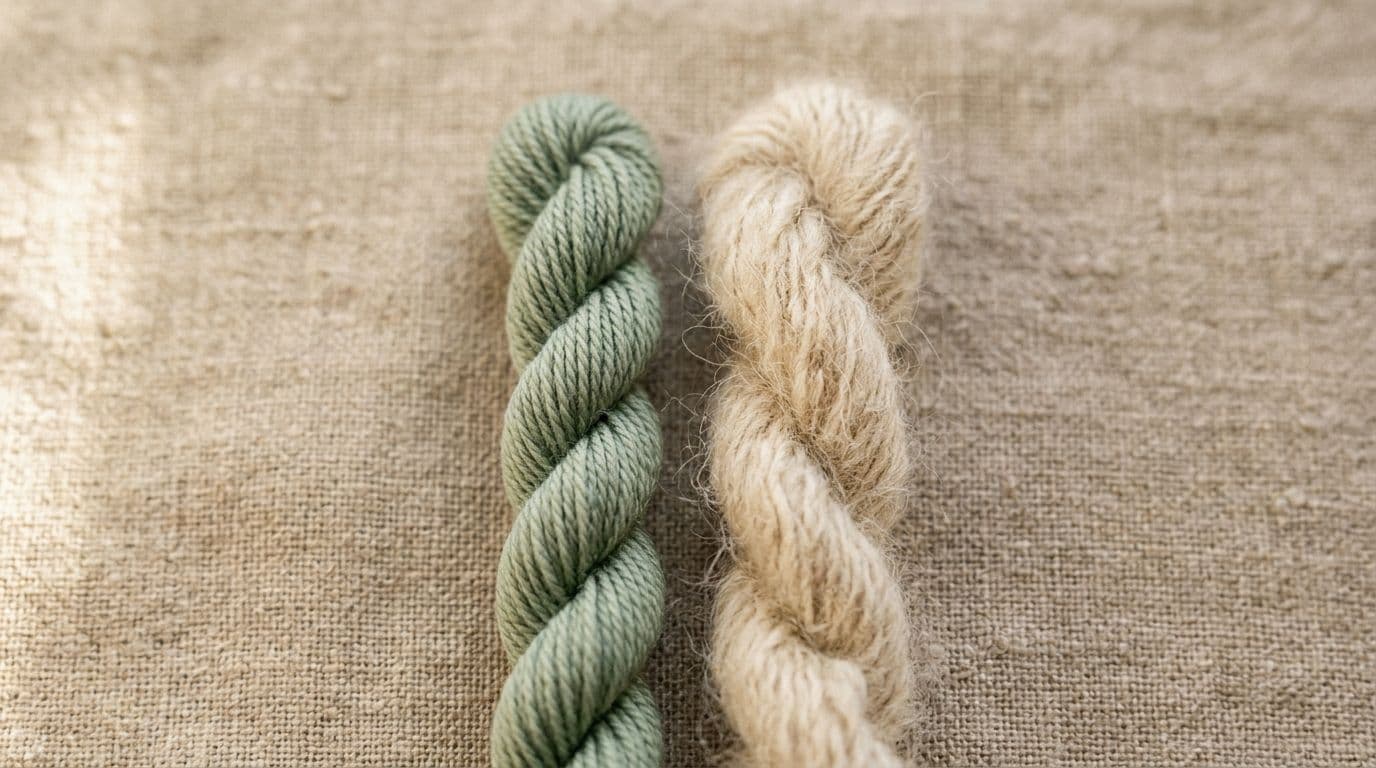
Two worsted-weight merino yarns can look completely different knitted up depending on how they're spun. A tightly plied, worsted-spun yarn gives excellent stitch definition cables pop, color work stays crisp. A loosely spun, woolen-spun single creates a halo and softness that can blur stitch pattern details. For lace or cables, always go with a smooth, plied yarn. For cozy stockinette and textured knits, loosely spun yarns are gorgeous.
5. Texture
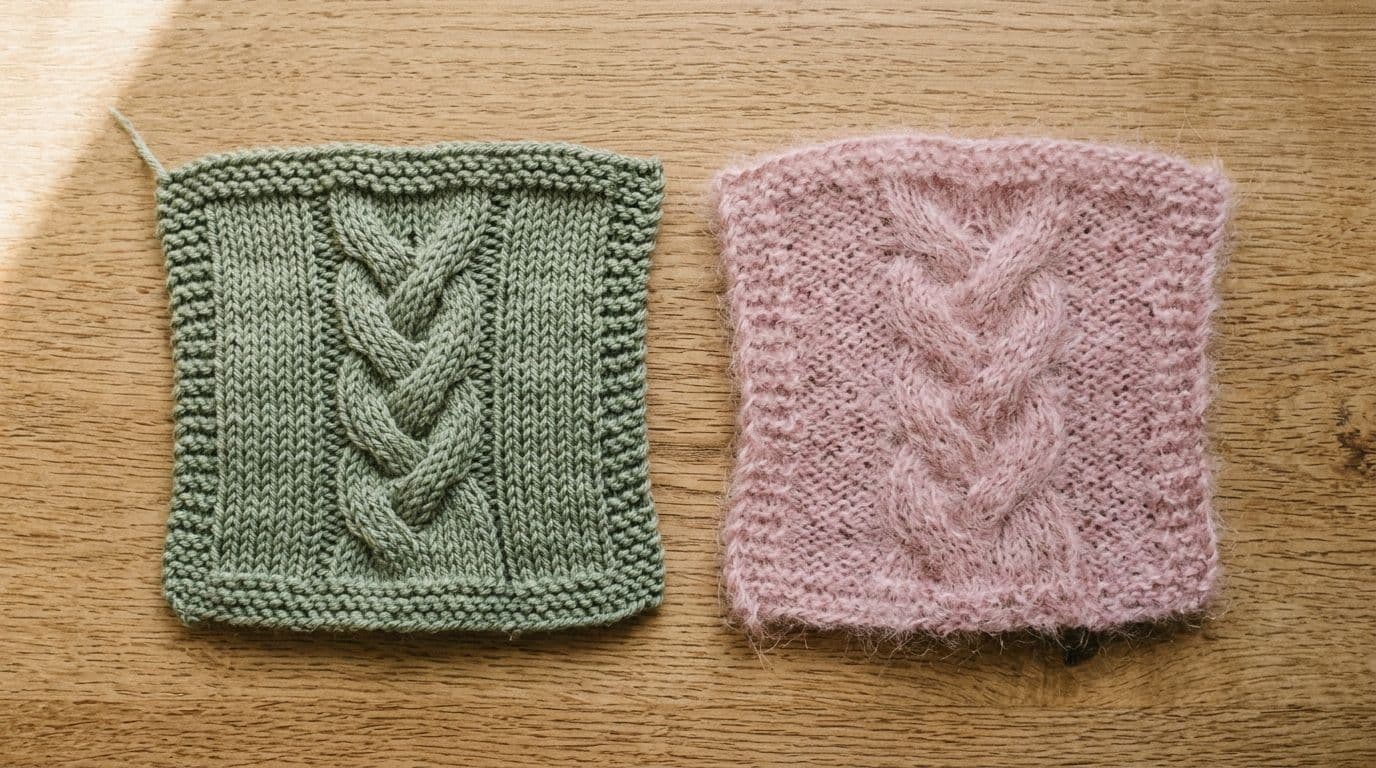
This is the gap in almost every competing guide. A fuzzy mohair blend will eat your cable pattern alive. A boucle yarn will hide every stitch of a complex lace shawl. Before substituting, ask yourself: does this pattern depend on seeing the stitches clearly? If yes, avoid hairy, textured, or highly variegated yarns. If the pattern is simple stockinette or garter, texture gives you a lot of creative freedom.
The same goes for variegated and hand-dyed yarns they can pool in strange ways on smaller needles and completely overpower color work patterns. They're magical in the right context, but they need to be a deliberate choice, not an afterthought.
6. Gauge Swatch
Every single competitor article mentions swatching. There's a reason. No matter how well you match all five factors above, your hands, your tension, and your needles are unique. Swatch at least a 6"×6" sample, wash it exactly as you'll wash the finished item, and measure after it dries. Your gauge will shift sometimes dramatically, after washing. This is the single most expensive mistake beginners make.
Choosing a Substitute by Project Type
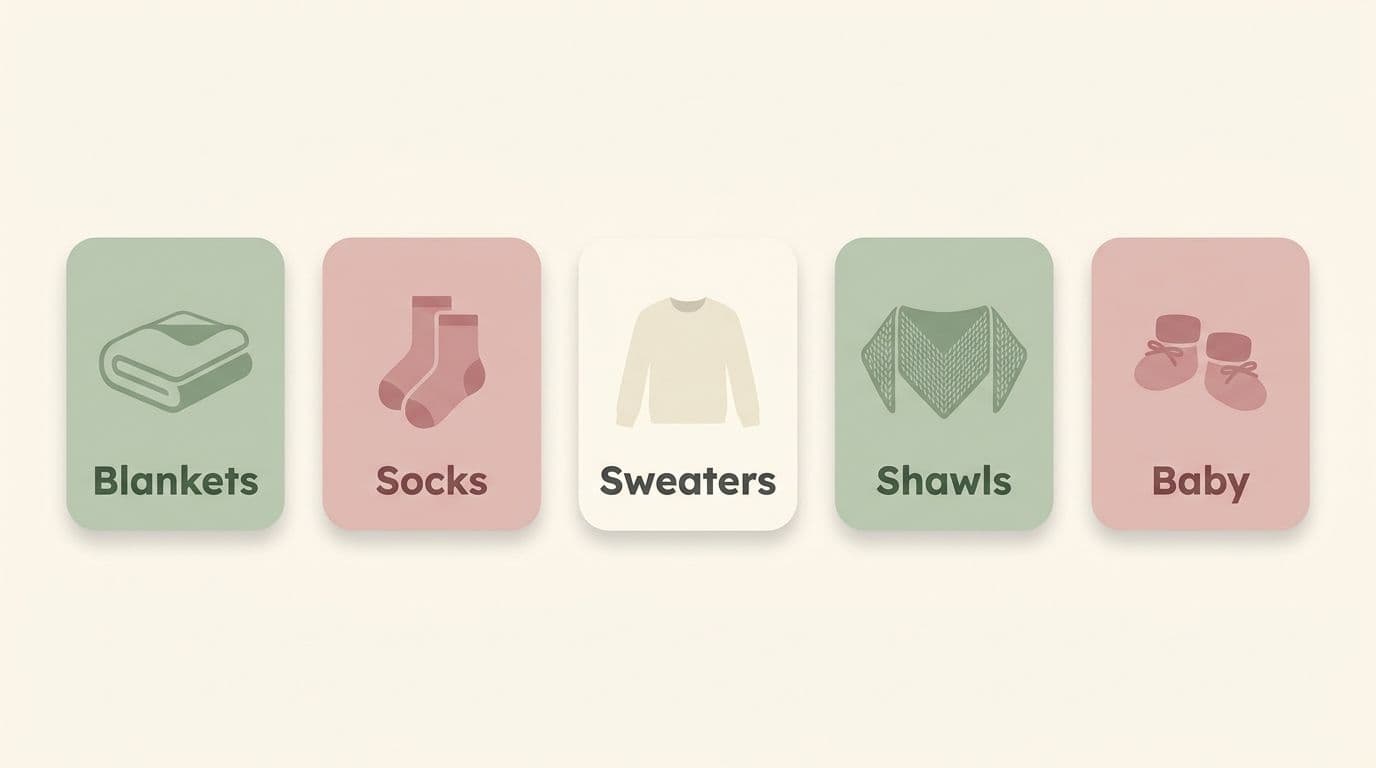
The "best" substitute depends entirely on what you're making. A choice that works brilliantly for a blanket can destroy a fitted sweater.
Blankets & Afghans
The most forgiving project type. Gauge matters but isn't critical to fit, so you have the most flexibility. Prioritize washability (machine-wash acrylic or superwash wool), softness, and yardage per dollar. Chenille and velvet-texture yarns work beautifully here. Best yarn substitute for a blanket: superwash bulky acrylic or a wool-acrylic blend gives the best softness-to-price ratio.
Socks
High stakes. You need minimum 20% nylon content for durability at the heel and toe. Pure wool socks wear through fast. Match yarn weight precisely (fingering) and prioritize a superwash treatment so they survive the machine. Steer clear of cotton it has no elasticity and won't hug the foot.
Sweaters & Garments
The highest stakes substitution. Every percentage point of gauge deviation changes your finished dimensions. Fiber elasticity is critical: swapping an elastic wool for inelastic cotton in a fitted pattern will give you a garment that grows and sags. If you must change the fiber category, go up a size in the pattern or do a full gauge adjustment.
Shawls & Lace
The most forgiving for gauge, most demanding for fiber drape. A shawl in wool can look structured and warm; the same pattern in a bamboo-silk blend becomes fluid and elegant. The drape of your substitute is the primary decision swatch and hang it before committing.
Baby Projects
Washability and softness above all else. Machine-washable superwash wool or high-quality acrylic. Avoid anything with a scratchy texture or loose fibers that shed. Many natural fibers that feel fine to adults can irritate sensitive skin swatch against the inside of your wrist.
Popular Brand-Specific Yarn Substitution Guide
DROPS Nepal Substitute
Aran-weight wool-alpaca blend (65% wool, 35% alpaca). Alternatives: Drops Air for lighter feel, Cascade 220 Superwash for machine washability, WeCrochet Swish DK held double.
DROPS Snow Substitute
Super bulky 100% wool, ~50m/100g. Substitute with Lion Brand Wool-Ease Thick & Quick or Bernat Blanket Extra note DROPS Snow is heavier than most US "super bulky" so check yardage carefully.
DROPS Lima Substitute
Aran-weight alpaca-wool (65% alpaca, 35% wool). The alpaca content gives exceptional drape. Replace with BC Garn Soft Silk or Rowan Alpaca Classic. Expect slightly different drapes if switching to 100% wool.
Scheepjes Catona Substitute
100% mercerised cotton, fingering/sport weight with excellent stitch definition. Substitutes: Paintbox Simply DK (one size up) or Drops Safran. Match the mercerised finish for the same sheen.

Looking for Bernat Yarn Substitutes? Because Bernat yarns have distinct textures (from chenille fleece to tubular cotton cord), swapping them requires exact fiber and gauge matching.
Read our full Bernat Yarn Substitutes Guide: Top Swaps for Blanket, Maker, Pipsqueak & Bundle Up for complete yardage charts and skein calculations.
Rowan Felted Tweed Substitute
DK-weight wool-alpaca-viscose blend with signature tweed flecks. Very specific texture hardest to substitute. Drops Soft Tweed or Malabrigo Rios (without flecks) are the closest in drape and weight.
Lion Brand Homespun Substitute
Bulky acrylic with a unique loopy texture. The texture is difficult to replicate exactly. For smoother substitutes: Red Heart Super Saver Chunky. For a similar drape: Bernat Blanket in the bulky size.
Premier Parfait Chunky Substitute
Bulky velvet/chenille polyester. Best like-for-like: Bernat Velvet Plus or Lion Brand Pound of Love Velvet. Measure yardage carefully chenille yarns vary widely in yardage per gram.
DROPS Air Substitute
Super light worsted alpaca-merino-nylon blend with exceptional softness. Hard to match exactly. Drops Alpaca (held double) or We Are Knitters The Merino Wool at a lighter tension are the closest.

Yarnzy Knows Your Stash Better Than You Do Log your yarn stash, get instant substitution suggestions from what you already own, and never buy a yarn you already have again.
Try Yarn Substitution tool Free
How to Find a Substitute for Discontinued Yarn
Finding a replacement for a yarn that no longer exists is a different problem than swapping available yarns. Here's a repeatable process that works even when the yarn label is long gone.
Dig up the discontinued yarn's key specs, yarn weight category, gauge (stitches per 4 inches), and total yardage required by your pattern. Even if the yarn is gone from shelves, these numbers are your starting point for everything.
Note the exact fiber composition percentage, not just the fiber type. A 75% wool / 25% nylon sock yarn behaves very differently from 80% merino / 20% silk, the percentage is where the personality of the yarn lives.
Look for the discontinued yarn's closest sibling in the same brand's current lineup. Many manufacturers quietly rename or reformulate yarns rather than fully discontinue them. The replacement is often sitting there under a new name.
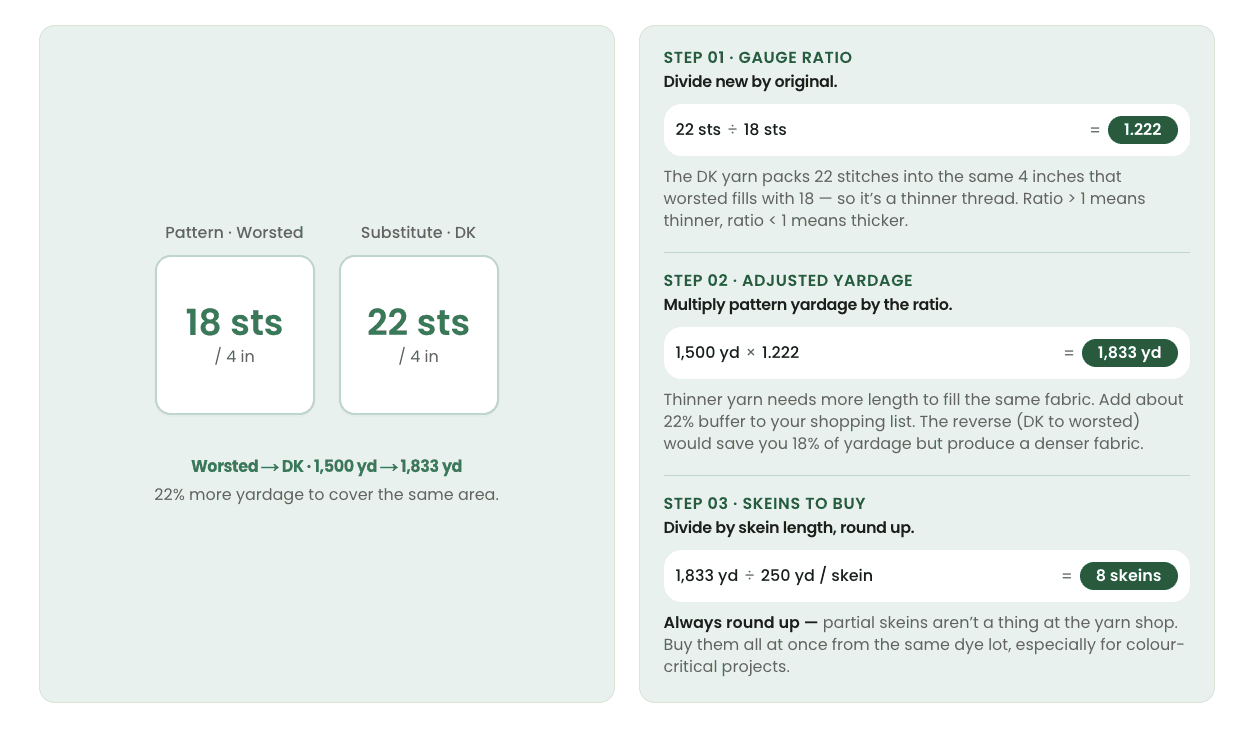
Once you have a candidate substitute, open Yarnzy's Yarn Substitution Tool. Enter your pattern yarn's weight and gauge, then enter your substitute yarn's weight and gauge. YarnZy instantly calculates the gauge ratio between the two yarns and tells you the adjusted yardage you'll need to buy, so you never run short.
If your substitute is a different weight than the original say DK instead of worsted. YarnZy does the gauge-ratio math automatically. It tells you exactly how much more (or less) yardage to buy to cover the same fabric area. No guessing, no manual calculation.
The Yarnzy Yarn Substitution Calculator: How It Works
Most guides tell you to "find a similar yarn and swatch." That's true, but it skips the most important question: how much of the substitute do you actually need to buy? That's exactly what the YarnZy Substitution Tool solves.
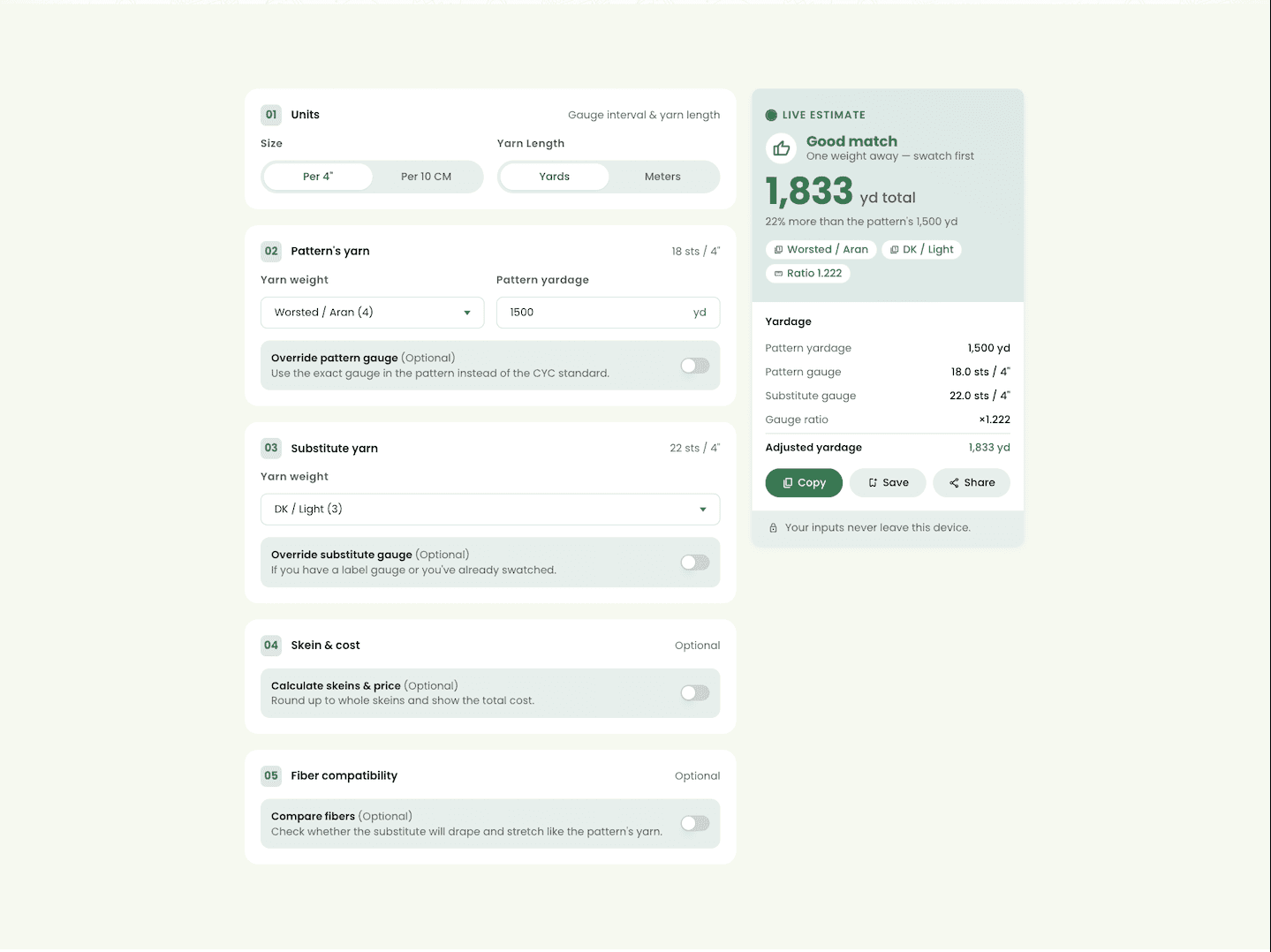
Here's how it works, step by step:
Step 1 Set Your Units
Choose whether you work in yards or meters, and whether your gauge is measured per 4 inches or per 10cm. Yarnzy works in both systems, so it doesn't matter whether your pattern is American or European.
Step 2 Enter Your Pattern Yarn Details
Input your pattern yarn's weight category and its total yardage requirement. If your pattern has a specific gauge printed on it (rather than the standard CYC gauge for that weight), you can override the standard gauge with the exact number; this makes the calculation even more accurate.
Step 3 Enter Your Substitute Yarn Details
Input your substitute yarn's weight category. If you've already swatched with it and know your personal gauge, enter that too. YarnZy uses this to calculate the true gauge ratio between your original and substitute yarn, not just a rough category match.
Step 4 Add Skein and Cost Details (Optional)
Enter your substitute skein's yardage and price. YarnZy rounds up to whole skeins automatically (because you can't buy half a skein) and shows you the total cost so you know exactly what you're spending before you hit the checkout.
Step 5 Compare Fiber Compatibility (Optional)
Turn on fiber comparison to check whether your substitute will drape and stretch the way the pattern's yarn does. This is the step most knitters and crocheters skip and the one that causes the most problems with fitted garments.
What YarnZy shows you instantly:
• A match quality rating whether your substitute is a good match, one weight away, or a significant stretch
• The gauge ratio between your original and substitute yarn (e.g. ×1.222 for worsted → DK)
• The adjusted total yardage you need to buy based on that ratio
• Exactly how many skeins to buy, rounded up to the nearest whole skein
• The total cost if you entered your skein price
A real example from the tool:
Substituting worsted (18 sts / 4") with DK (22 sts / 4") on a pattern that calls for 1,500 yards? YarnZy calculates a gauge ratio of ×1.222 and tells you that you need 1,833 yards of the DK substitute 22% more than the pattern states because the thinner yarn needs more length to cover the same fabric area. It then divides by your skein yardage and tells you to buy 8 skeins. All in under a minute.
Try it free no sign-up needed: Yarn Substitution
Also available inside the YarnZy app on iOS and Android, calculate on the go while you're standing in the yarn shop.
Vegan and Allergy-Friendly Yarn Substitutions
If the original yarn contains animal fibers and you need a vegan alternative or you're knitting for someone with wool sensitivity, here's what to look for. Most guides completely ignore this section despite it being a real, common need.
Best vegan substitutes by category:
| Original Fiber | Vegan Alternative | Trade-off |
|---|---|---|
| Wool (warmth) | High-quality acrylic (e.g. Paintbox, Drops Lima) | Less breathable, more pilling |
| Wool (drape) | Bamboo, Tencel, or viscose blend | No elasticity size up in garments |
| Cashmere | High-micron bamboo or cotton-modal blend | Less warmth retention |
| Alpaca | Bamboo-acrylic blend | Lighter weight, less halo effect |
| Silk | Bamboo or Tencel (very similar sheen) | Slightly less temperature regulation |
| Mohair | Brushed acrylic or polyester halo yarn | Less breathable, similar halo effect |
Yarn Substitution for Crochet: What's Different?
Every article ranking above this one is written purely for knitters. Crochet uses approximately 30% more yarn than the equivalent knitting project, so if a substitution guide doesn't mention this, it's not written for you.
Beyond yardage, crochet creates a denser, stiffer fabric than knitting by default. This means:
• Drape matters more in crochet garments: use yarns with natural drape (bamboo, cotton, Tencel) or go up a hook size when substituting with stiffer fibers.
• For amigurumi and stuffed animals, you want the opposite: a tight, firm fabric so stuffing doesn't show through. Stick to smooth, tightly plied cotton or acrylic in the correct gauge.
• Crochet eats texture. A highly textured or mohair-halo yarn will make it nearly impossible to see your stitches or frog if you make a mistake.
• When checking gauge for crochet, always swatch in the stitch pattern called for in the pattern, sc, dc, and granny squares all produce different densities.
Common Yarn Substitution Mistakes (and How to Avoid Them)
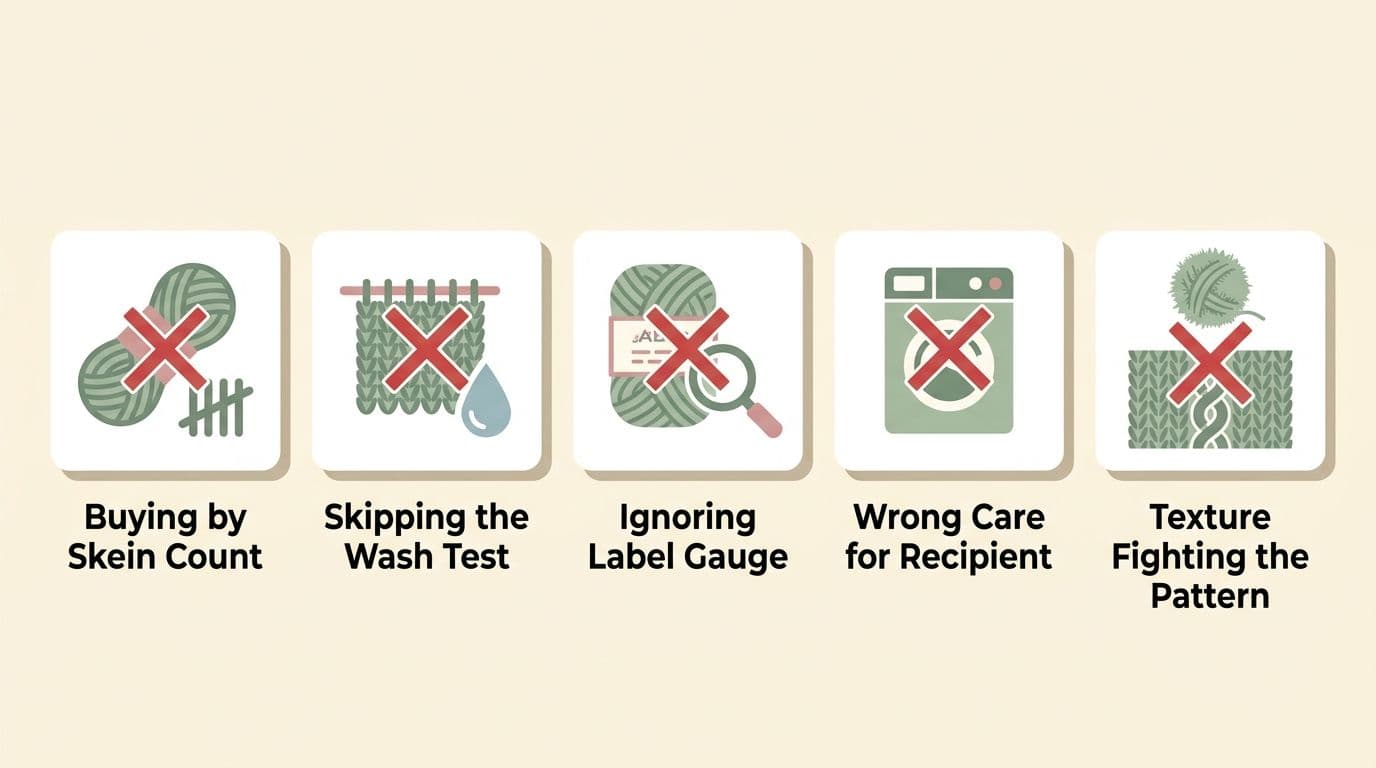
This is the content gap no competitor covers: not just what to do, but what goes wrong and why.
Buying by skein count, not yardage
The most expensive mistake. Always calculate total project yardage and compare it to the substitute's yardage per skein, not just the count on the pattern.
Swatching but not washing the swatch
Your gauge before and after washing can differ by 10–20%. Cotton typically relaxes and widens; superwash wool can bloom. Always wash your swatch exactly as you'd wash the finished item.
Matching weight class but ignoring the label gauge
All worst is not equal. Always compare the label gauge of the original and substitute, not just the weight category name.
Ignoring care requirements for the recipient
A hand-wash-only silk blend is beautiful unless you're knitting for a toddler or someone who will toss it in the machine. Always design for the end user's lifestyle.
Using a textured yarn in a stitch-definition pattern
Boucle, mohair, and highly variegated yarns all compete with the pattern rather than enhancing it. Reserve these for simple stitches; they shine in stockinette, not in cables or lace.
Estimate the Right Amount of Yarn Every Time Calculate how much yarn your project needs, estimate yardage, and avoid running short or buying more than necessary.
Use the Yarn Calculator
Conclusion
A good yarn substitution isn't about finding an identical twin, it's about understanding your project's real requirements and finding a yarn that meets them. A shawl needs drape. A sock needs durability. A baby blanket needs washability. A cable sweater needs stitch definition. Start there.
Match weight first, then yardage per gram, then fiber behaviour. Swatch. Wash the swatch. Measure again. Buy 15% extra. That process done in that order will save you from 95% of the substitution disasters that happen to knitters and crocheters every day.
Use the calculators above before every substitution, bookmark the brand-specific section for quick reference, and trust your swatch over every instinct you have about how a yarn will behave in the ball. The yarn always knows something the label doesn't.
Frequently Asked Questions
The best wool substitute depends on why you're avoiding it. For warmth without animal fiber, high-quality acrylic (like Drops Lima or Paintbox Yarns) is the closest in gauge and behaviour. For softness, bamboo or a bamboo-cotton blend. For draping in garments, Tencel or viscose. Note that all of these have lower elasticity than wool, so size up slightly for fitted garments.
Share this page
 X / Twitter
 Facebook
 Reddit
Related articles
Bernat Yarn Substitutes: What to Use Instead of Blanket, Maker, Pipsqueak & Bundle Up

How to Crochet a Pumpkin: Free Patterns for Fall & Halloween Decor
How to Read Crochet Patterns: A Beginner's Guide

Yarnzy: #1 Crochet & Knitting App
Track knitting and crochet projects with a timer & row counter, Import Patterns from Anywhere, Manage Stash & more all in one place.


Free to start · iOS, Android & Web
Scan to Download the App

Start your next project with confidence